
Here are the results from the Protactinium Generator Experiment. Your task is to correct for background (take the background count per second away from the count rate) and then plot a graph of count rate (cps) against time (s). Remember the count rate was taken every 10 s but shows the value of the count rate (for one second)
Background count rate (c.p.m.) 48.0, 46.0, 42.0
Average background count rate (c.p.m.) 45.3
Average background per second (c.p.s.) work it out!
| Type | Year | No. | Q Part | Answer | Comments |
|---|---|---|---|---|---|
| Trad | 2001 | 4 | b | a (OR F) a -x object has constant speed | Usual now to use -y rather than -x but generally both accepted. Y is usual for displacement at AH |
| Trad | 2001 | 5 | aii | (Electrostatic potential at a point) is the work done per unit charge moveing the charge from infinity to the point | |
| Trad | 2001 | 11 | a | electric field vibrates in all directions in unpolarised light vibrates in one plane only in polaried light | original version in 2001 accepted direction. This would no longer get the mark |
| Trad | 2002 | 3 | ci | velocity required by a body to escape earth gravitational field by reaching infinity | |
| Trad | 2002 | 5 | ai | diffraction pattern produced by electon beam | |
| Trad | 2002 | 10 | cii | wavelength has incerased therfore the source is moving away from the observer | |
| Trad | 2006 | 3 | ai | Force exerted on 1 kg (of mass) placed in the field | |
| Trad | 2006 | 11 | c | (Path length) in oil depends on angle of incidence or thickness ∴different colours are seen due to interference | |
| Trad | 2009 | 8 | b | One tesla is the magnetic induction of a magnetic field in which a conductor of length one metre, carrying a current of one ampere (perpendicular) to the field is acted on by a force of one newton. | |
| Trad | 2009 | 9 | ai | Division of amplitude is when some of the light reflects from the top of the air wedge and some is transmitted/refracted into the air. OR Some of the light is reflected from a surface of a new material/medium and some of the light is transmitted/refracted into the new material/medium. | |
| Trad | 2009 | 10 | a | A stationary wave is caused by interference effects between the incident and reflected sound. | |
| Trad | 2009 | 10 | b | The antinodes of the pattern are areas of maximum displacement/amplitude/disturbance The nodes of the pattern are areas of minimum/zero displacement/amplitude/disturbance | |
| Trad | 2010 | 4 | a | Total angular momentum before (an event) = total angular momentum after (an event) in the absence of external torques | |
| Trad | 2010 | 6 | bii | E-field is zero inside a hollow conductor. E-field has inverse square dependence outside the conductor. | |
| Trad | 2010 | 11 | a | unpolarised light => Electric field vector oscillates or vibrates in all planes polarised light => Electric field vector oscillates or vibrates in one plane | |
| Trad | 2014 | 3 | ai | The (minimum) velocity/speed that a mass must have to escape the gravitational field (of a planet). | |
| Trad | 2014 | 4 | ai | The unbalanced force/ acceleration is proportional to the displacement of the object and act in the opposite direction. | |
| rev | 2014 | 4 | ai | The distance from the centre of a black hole at which not even light can escape. or The distance from the centre of a black hole to the event horizon. | |
| Trad | 2014 | 5 | di | Electron orbits a nucleus / proton , Angular momentum quantised or Certain allowed orbits / discrete energy level | |
| rev | 2014 | 6 | aii | Photoelectric effect or Compton scattering Collision and transfer of energy | |
| rev | 2014 | 6 | di | Electron orbits a nucleus / proton (1) Angular momentum quantised (1) or Certain allowed orbits / discrete energy level | |
| rev | 2014 | 8 | a | The unbalanced force/ acceleration is proportional to the displacement of the object and act in the opposite direction. | |
| Trad | 2014 | 11 | c | Wavelengths in the middle of the visible spectrum not reflected or destructively interfere. Red and blue reflected / combined to (form purple). | |
| Trad | 2014 | 13 | aii | The brightness would gradually reduce from a maximum at 0 degrees to no intensity at 90 degrees. It would then gradually increase in intensity from 90 degrees to 180 where it would again be at a maximum | |
| Rev | 2015 | 1 | c | The speed of the mass will be less. Second mark for correct justification. eg: Flywheel has greater moment of inertia Flywheel will be more difficult to start moving Smaller acceleration of flywheel More energy required to achieve same angular velocity. | |
| Rev | 2015 | 2 | a | Massive objects curve spacetime Other objects follow a curved path through this (distorted) spacetime | |
| Rev | 2015 | 2 | c | Time passes more slowly at lower altitudes (in a gravitational field). or Lower gravitational field strength at higher altitude. | |
| Trad | 2015 | 3 | biii | Potential is work done (per unit mass) moving from infinity to that point. or Infinity defined as zero potential. Work will be done by the field on the mass. or A negative amount of work will be done to move an object from infinity to any point. or WD by gravity in moving to that point or Force acts in opposite direction to r. | |
| Rev | 2015 | 5 | aiii | Difficult scale to read/information from diagram can only be read to 1 s.f. | |
| Rev | 2015 | 6 | ai | Force acting on (acceleration of) object is directly proportional to and in the opposite direction to its displacement. (from equilibrium) | |
| Rev | 2015 | 7 | aii | l reduced (or f increased) for X-rays or >E transferred D x reduced for X-rays since D x D p ³ h/4 p D p increases | |
| Rev | 2015 | 7 | b | since DEDt³ h/4 p Borrowing energy for a short period of time allows particles to escape | |
| Rev | 2015 | 8 | ai | Two sets of coherent waves are necessary (for an interference pattern) or (Interference patterns can be produced by) Division of wavefront. | |
| Rev | 2015 | 9 | ai | Force acts on particle at right angles to the direction of its velocity/motion or a central force on particle. | |
| Rev | 2015 | 9 | b | (Component of) velocity at right angles to field/ v sin θ, results in circular motion/central force. (Component of) velocity parallel to field/ v cosθ is constant/no unbalance force (in this direction). | |
| Trad | 2015 | 9 | bi | Magnetic fields/induction are equal in magnitude (½) and opposite in direction | |
| Rev | 2015 | 10 | ai | Force exerted per (unit) charge is constant at any point in the field | |
| Rev | 2015 | 10 | aiv | Any suitable answer eg Systematic uncertainty in measuring d or V Alignment of metre stick The flame has a finite thickness so cannot get exactly to the zero point. Factors causing field to be non-uniform. A p.d. across the resistor for all readings. Poor calibration of instruments measuring V or d. | |
| Rev | 2015 | 10 | b | Deflection is less. E is less. Force/acceleration is less | |
| Rev | 2015 | 12 | biii | Rate of change of current/magnetic field is at its maximum | |
| Trad | 2016 | 5 | ai | Frames of reference that are accelerating (with respect to an inertial frame) | |
| Trad | 2016 | 5 | aii | It is impossible to tell the difference between the effects of gravity and acceleration. | |
| Trad | 2016 | 8 | aii | The precise position of a particle/ system and its momentum cannot both be known at the same instant. OR If the uncertainty in the energy of the particle is reduced, the minimum uncertainty in the lifetime of the particle will increase (or vice-versa). | |
| Trad | 2016 | 10 | ai | displacement is proportional to and in the opposite direction to the acceleration |
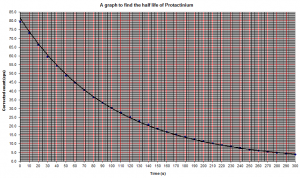
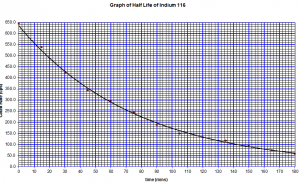
Indium 116 Half Life
Here are the results for the Indium-116 half life experiment. Warning, do not plot a graph in 15 minute intervals or you will have more difficulty finding the half life. Make the scale ten minute intervals.
You can track the experiment yourself through the link below
Background count = 31 c.p.m.
| Comments | Links |
|---|---|
 |
|
| AH-Compendium 2025 with contents AH-Compendium 2025 with contents AH Compendium word AH Compendium pdf |  |
| Relationships Sheet CfE-AH-relationship-sheet | 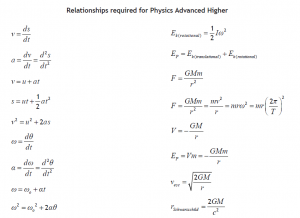 |
| AH Relationships Sheet Annotated word AH Relationships Sheet Annotated pdf | 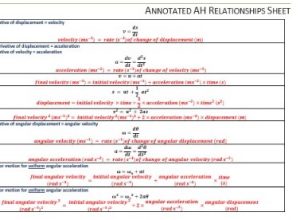 |
| Data Sheet word Data Sheet pdf editable data sheet | 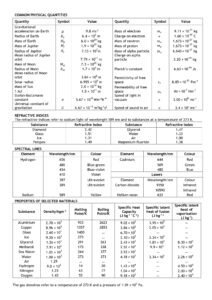 |
| AHPhysicsCourseSpec |  |
| general-marking-principles-physics General Marking Principles powerpoint to check you're understanding how your paper will be marked General Marking Principles powerpoint General Marking Principles for pdf |  |
| Tutorial AH Questions |  |
| Graph Paper |  |
| 10-Week-Revision-Plan-AH |  |
| Excel Tables for AH 2020 Excel Help AH EXTENSION 2020 word |  |
| AH Physics Project Advice for Teachers |  |
| set your calculator pdf set your calculator word Try to get hold of one of these square button Casio Classwiz- they're FAN-TAS-TIC |  |
| using calculator buttons The New Casio- avoid if possible! |  |
Here are three more examples for you to practice producing a half life graph and for finding the half life of Protactinium
Example 1:
Background Count (cps): 5, 5, 3, 5, 4, 5, 5.
Example 2:
Background Count (cps): 4, 3, 5.
| N | H | A | Physical Quantity | sym | Unit | Unit Abb. |
|---|---|---|---|---|---|---|
| 5 | absorbed dose | D | gray | Gy | ||
| 5 | absorbed dose rate | H (dot) | gray per second gray per hour gray per year | Gys -1 Gyh -1 Gyy -1 | ||
| 5 | 6 | 7 | acceleration | a | metre per second per second | m s -2 |
| 5 | 6 | 7 | acceleration due to gravity | g | metre per second per second | m s -2 |
| 5 | activity | A | becquerel | Bq | ||
| 5 | 6 | 7 | amplitude | A | metre | m |
| 5 | 6 | 7 | angle | θ | degree | ° |
| 5 | 6 | 7 | area | A | square metre | m 2 |
| 5 | 6 | 7 | average speed | v (bar) | metre per second | m s -1 |
| 5 | 6 | 7 | average velocity | v (bar) | metre per second | m s -1 |
| 5 | 6 | 7 | change of speed | ∆v | metre per second | m s -1 |
| 5 | 6 | 7 | change of velocity | ∆v | metre per second | m s -1 |
| 5 | count rate | - | counts per second (counts per minute) | - | ||
| 5 | 6 | 7 | current | I | ampere | A |
| 5 | 6 | 7 | displacement | s | metre | m |
| 5 | 6 | 7 | distance | d | metre, light year | m , ly |
| 5 | 6 | 7 | distance, depth, height | d or h | metre | m |
| 5 | effective dose | H | sievert | Sv | ||
| 5 | 6 | 7 | electric charge | Q | coulomb | C |
| 5 | 6 | 7 | electric charge | Q or q | coulomb | C |
| 5 | 6 | 7 | electric current | I | ampere | A |
| 5 | 6 | 7 | energy | E | joule | J |
| 5 | equivalent dose | H | sievert | Sv | ||
| 5 | equivalent dose rate | H (dot) | sievert per second sievert per hour sievert per year | Svs -1 Svh -1 Svy -1 | ||
| 5 | 6 | 7 | final velocity | v | metre per second | m s -1 |
| 5 | 6 | 7 | force | F | newton | N |
| 5 | 6 | 7 | force, tension, upthrust, thrust | F | newton | N |
| 5 | 6 | 7 | frequency | f | hertz | Hz |
| 5 | 6 | 7 | gravitational field strength | g | newton per kilogram | N kg -1 |
| 5 | 6 | 7 | gravitational potential energy | E p | joule | J |
| 5 | half-life | t 1/2 | second (minute, hour, day, year) | s | ||
| 5 | 6 | heat energy | Eh | joule | J | |
| 5 | 6 | 7 | height, depth | h | metre | m |
| 5 | 6 | 7 | initial speed | u | metre per second | m/s |
| 5 | 6 | 7 | initial velocity | u | metre per second | m s -1 |
| 5 | 6 | 7 | kinetic energy | Ek | joule | J |
| 5 | 6 | 7 | length | l | metre | m |
| 5 | 6 | 7 | mass | m | kilogram | kg |
| 5 | number of nuclei decaying | N | - | - | ||
| 5 | 6 | 7 | period | T | second | s |
| 5 | 6 | 7 | potential difference | V | volt | V |
| 5 | 6 | 7 | potential energy | Ep | joule | J |
| 5 | 6 | 7 | power | P | watt | W |
| 5 | 6 | 7 | pressure | P or p | pascal | Pa |
| 5 | radiation weighting factor | wR | - | - | ||
| 5 | 6 | 7 | radius | r | metre | m |
| 5 | 6 | 7 | resistance | R | ohm | Ω |
| 5 | 6 | 7 | specific heat capacity | c | joule per kilogram per degree Celsius | Jkg-1 °C -1 |
| 5 | 6 | specific latent heat | l | joule per kilogram | Jkg -1 | |
| 5 | 6 | 7 | speed of light in a vacuum | c | metre per second | m s -1 |
| 5 | 6 | 7 | speed, final speed | v | metre per second | ms -1 |
| 5 | 6 | 7 | speed, velocity, final velocity | v | metre per second | m s-1 |
| 5 | 6 | 7 | supply voltage | Vs | volt | V |
| 5 | 6 | 7 | temperature | T | degree Celsius | °C |
| 5 | 6 | 7 | temperature | T | kelvin | K |
| 5 | 6 | 7 | time | t | second | s |
| 5 | 6 | 7 | total resistance | R | ohm | Ω |
| 5 | 6 | 7 | voltage | V | volt | V |
| 5 | 6 | 7 | voltage, potential difference | V | volt | V |
| 5 | 6 | 7 | volume | V | cubic metre | m3 |
| 5 | 6 | 7 | weight | W | newton | N |
| 5 | 6 | 7 | work done | W or E W | joule | J |
| 7 | angle | θ | radian | rad | ||
| 7 | angular acceleration | a | radian per second per second | rad s -2 | ||
| 7 | angular displacement | θ | radian | rad | ||
| 7 | angular frequency | ω | radian per second | rad s -1 | ||
| 7 | angular momentum | L | kilogram metre squared per second | kg m2 s -1 | ||
| 7 | angular velocity, final angular velocity | ω | radian per second | rad s-1 | ||
| 7 | apparent brightness | b | Watts per square metre | Wm-2 | ||
| 7 | back emf | e | volt | V | ||
| 6 | 7 | capacitance | C | farad | F | |
| 7 | capacitive reactance | Xc | ohm | W | ||
| 6 | critical angle | θc | degree | ° | ||
| density | ρ | kilogram per cubic metre | kg m-3 | |||
| 7 | displacement | s or x or y | metre | m | ||
| efficiency | η | - | - | |||
| 6 | 7 | electric field strength | E | newton per coulomb volts per metre | N C -1 Vm -1 |
|
| 7 | electrical potential | V | volt | V | ||
| 6 | 7 | electromotive force (e.m.f) | E or ε | volt | V | |
| 6 | energy level | E 1 , E 2 , etc | joule | J | ||
| feedback resistance | Rf | ohm | Ω | |||
| focal length of a lens | f | metre | m | |||
| 6 | frequency of source | fs | hertz | Hz | ||
| 6 | 7 | fringe separation | ∆x | metre | m | |
| 6 | 7 | grating to screen distance | D | metre | m | |
| 7 | gravitational potential | U or V | joule per kilogram | J kg-1 | ||
| half-value thickness | T1/2 | metre | m | |||
| 6 | 7 | impulse | (∆p) | newton second kilogram metre per second | Ns kgms-1 |
|
| 7 | induced e.m.f. | E or ε | volt | V | ||
| 7 | inductor reactance | XL | ohm | W | ||
| 7 | initial angular velocity | ω o | radian per second | rad s-1 | ||
| input energy | E i | joule | J | |||
| input power | Pi | watt | W | |||
| input voltage | V 1 or V2 | volt | V | |||
| input voltage | V i | volt | V | |||
| 6 | internal resistance | r | ohm | Ω | ||
| 6 | 7 | irradiance | I | watt per square metre | W m-1 | |
| 7 | luminoscity | L | Watt | W | ||
| 7 | magnetic induction | B | tesla | T | ||
| 7 | moment of inertia | I | kilogram metre squared | kg m2 | ||
| 6 | 7 | momentum | p | kilogram metre per second | kg m s-1 | |
| 6 | number of photons per second per cross sectional area | N | - | - | ||
| number of turns on primary coil | n p | - | - | |||
| number of turns on secondary coil | n s | - | - | |||
| 6 | observed wavelength | λ observed | metre | m | ||
| output energy | E o | joule | J | |||
| output power | P o | watt | W | |||
| output voltage | V o | volt | V | |||
| 6 | peak current | Ipeak | ampere | A | ||
| 6 | peak voltage | V peak | volt | V | ||
| 7 | phase angle | Φ | radian | rad | ||
| 6 | 7 | Planck’s constant | h | joule second | Js | |
| 7 | polarising angle (Brewster’s angle) | i p | degree | ̊ | ||
| power (of a lens) | P | dioptre | D | |||
| power gain | Pgain | - | - | |||
| 7 | Power per unit area | Watts per square metre | Wm-2 | |||
| primary current | I p | ampere | A | |||
| primary voltage | Vp | volt | V | |||
| 7 | radial acceleration | ar | metre per second per second | m s-2 | ||
| 6 | redshift | z | - | - | ||
| 6 | 7 | refractive index | n | - | - | |
| 6 | relativistic length | l' | metre | m | ||
| 6 | relativistic time | t' | second | s | ||
| rest mass | mo | kilogram | kg | |||
| 6 | rest wavelength | λrest | metre | m | ||
| 6 | root mean square current | I rms | ampere | A | ||
| 6 | root mean square voltage | Vrms | volt | V | ||
| 7 | rotational kinetic energy | Erot | joule | J | ||
| 7 | schwarzchild radius | rSchwarzchild | metre | m | ||
| secondary current | Is | ampere | A | |||
| secondary voltage | Vs | volt | V | |||
| 7 | self-inductance | L | henry | H | ||
| 6 | 7 | slit separation | d | metre | m | |
| 7 | tangential acceleration | at | metre per second per second | m s-2 | ||
| 6 | threshold frequency | fo | hertz | Hz | ||
| 7 | time constant | t | second | s | ||
| 7 | torque | Τ | newton metre | Nm | ||
| 7 | uncertainty in Energy | ∆E | joule | J | ||
| 7 | uncertainty in momentum | ∆px | kilogram metre per second | kgms-1 | ||
| 7 | uncertainty in position | ∆x | metre | m | ||
| 7 | uncertainty in time | ∆t | second | s | ||
| 6 | velocity of observer | vo | metre per second | m s-1 | ||
| 6 | velocity of source | vs | metre per second | m s-1 | ||
| voltage gain | - | - | - | |||
| voltage gain | Ao or V gain | - | - | |||
| 5 | 6 | 7 | wavelength | λ | metre | m |
| 6 | work function | W | joule | J |
Example 3:
| Type | Yr | Q No. | Answer |
|---|---|---|---|
| Trad | 2001 | 4 b | a (OR F) is directly proportional to -x Usual now to use -y rather than -x |
| Trad | 2001 | 5 aii | (Electrostatic potential at a point) is the work done per unit charge moveing the charge from infinity to the point |
| Trad | 2001 | 11 a | electric field vibrates in all directions in unpolarised light vibrates in one plane only in polaried light |
| Trad | 2002 | 3 ci | velocity required by a body to escape earth gravitational field by reaching infinity |
| Trad | 2002 | 5 ai | diffraction pattern produced by electon beam |
| Trad | 2002 | 10 cii | wavelength has incerased therfore the source is moving away from the observer |
| Trad | 2006 | 3 ai | Force exerted on 1 kg (of mass) placed in the field |
| Trad | 2006 | 11 c | (Path length) in oil depends on angle of incidence or thickness ∴different colours are seen due to interference |
| Trad | 2009 | 8 b | One tesla is the magnetic induction of a magnetic field in which a conductor of length one metre, carrying a current of one ampere (perpendicular) to the field is acted on by a force of one newton. |
| Trad | 2009 | 9 ai | Division of amplitude is when some of the light reflects from the top of the air wedge and some is transmitted/refracted into the air. OR Some of the light is reflected from a surface of a new material/medium and some of the light is transmitted/refracted into the new material/medium. |
| Trad | 2009 | 10 a | A stationary wave is caused by interference effects between the incident and reflected sound. |
| Trad | 2009 | 10 b | The antinodes of the pattern are areas of maximum displacement/amplitude/disturbance The nodes of the pattern are areas of minimum/zero displacement/amplitude/disturbance |
| Trad | 2010 | 4 a | Total angular momentum before (an event) = total angular momentum after (an event) in the absence of external torques |
| Trad | 2010 | 6 bii | E-field is zero inside a hollow conductor. E-field has inverse square dependence outside the conductor. |
| Trad | 2010 | 11 a | unpolarised light => Electric field vector oscillates or vibrates in all planes polarised light => Electric field vector oscillates or vibrates in one plane |
| Trad | 2014 | 3 ai | The (minimum) velocity/speed that a mass must have to escape the gravitational field (of a planet). |
| Trad | 2014 | 4 ai | The unbalanced force/ acceleration is proportional to the displacement of the object and act in the opposite direction. |
| Rev | 2014 | 4 aii | The distance from the centre of a black hole at which not even light can escape. or The distance from the centre of a black hole to the event horizon. |
| Trad | 2014 | 5 di | Electron orbits a nucleus / proton , Angular momentum quantised or Certain allowed orbits / discrete energy level |
| Rev | 2014 | 6 aii | Photoelectric effect or Compton scattering Collision and transfer of energy |
| Rev | 2014 | 6 di | Electron orbits a nucleus / proton (1) Angular momentum quantised (1) or Certain allowed orbits / discrete energy level |
| Rev | 2014 | 8 a | The unbalanced force/ acceleration is proportional to the displacement of the object and act in the opposite direction. |
| Trad | 2014 | 11c | Wavelengths in the middle of the visible spectrum not reflected or destructively interfere. Red and blue reflected / combined to (form purple). |
| Trad | 2014 | 13 aii | The brightness would gradually reduce from a maximum at 0 degrees to no intensity at 90 degrees. It would then gradually increase in intensity from 90 degrees to 180 where it would again be at a maximum |
| Rev | 2015 | 1 c | The speed of the mass will be less. Second mark for correct justification. eg: Flywheel has greater moment of inertia Flywheel will be more difficult to start moving Smaller acceleration of flywheel More energy required to achieve same angular velocity. |
| Rev | 2015 | 2 a | Massive objects curve spacetime Other objects follow a curved path through this (distorted) spacetime |
| Rev | 2015 | 2 c | Time passes more slowly at lower altitudes (in a gravitational field). or Lower gravitational field strength at higher altitude. |
| Trad | 2015 | 3 biii | Potential is work done (per unit mass) moving from infinity to that point. or Infinity defined as zero potential. Work will be done by the field on the mass. or A negative amount of work will be done to move an object from infinity to any point. or WD by gravity in moving to that point or Force acts in opposite direction to r. |
| Rev | 2015 | 5 aiii | Difficult scale to read/information from diagram can only be read to 1 s.f. |
| Rev | 2015 | 6 ai | Force acting on (acceleration of) object is directly proportional to and in the opposite direction to its displacement. (from equilibrium) |
| Rev | 2015 | 7 aii | l reduced (or f increased) for X-rays or >E transferred D x reduced for X-rays since D x D p ³ h/4 p D p increases |
| Rev | 2015 | 7 b | since DEDt³ h/4 p Borrowing energy for a short period of time allows particles to escape |
| Rev | 2015 | 8 ai | Two sets of coherent waves are necessary (for an interference pattern) or (Interference patterns can be produced by) Division of wavefront. |
| Rev | 2015 | 9 ai | Force acts on particle at right angles to the direction of its velocity/motion or a central force on particle. |
| Rev | 2015 | 9 b | (Component of) velocity at right angles to field/ v sin θ, results in circular motion/central force. (Component of) velocity parallel to field/ v cosθ is constant/no unbalance force (in this direction). |
| Trad | 2015 | 9 bi | Magnetic fields/induction are equal in magnitude (½) and opposite in direction |
| Rev | 2015 | 10 ai | Force exerted per (unit) charge is constant at any point in the field |
| Rev | 2015 | 10 aiv | Any suitable answer eg Systematic uncertainty in measuring d or V Alignment of metre stick The flame has a finite thickness so cannot get exactly to the zero point. Factors causing field to be non-uniform. A p.d. across the resistor for all readings. Poor calibration of instruments measuring V or d. |
| Rev | 2015 | 10 b | Deflection is less. E is less. Force/acceleration is less |
| Rev | 2015 | 12 biii | Rate of change of current/magnetic field is at its maximum |
| Trad | 2016 | 5 ai | Frames of reference that are accelerating (with respect to an inertial frame) |
| Trad | 2016 | 5 aii | It is impossible to tell the difference between the effects of gravity and acceleration. |
| Trad | 2016 | 8 aii | The precise position of a particle/ system and its momentum cannot both be known at the same instant. OR If the uncertainty in the energy of the particle is reduced, the minimum uncertainty in the lifetime of the particle will increase (or vice-versa). |
| Trad | 2016 | 10 ai | displacement is proportional to and in the opposite direction to the acceleration |
You should now have had plenty of practice at finding the half life graphically, nothing should phase you now.



