It looks like some of you are going to be doing the electricity unit online. This is tricky but we’ll try to do as much practical as possible.
Please read the RISK ASSESSMENT IF WORKING FROM HOME
| Hazard | Control Measures |
|---|---|
| Rechargeable Cells or PP3s | Do not use rechargeable cells, lithium batteries or PP3s (the flat ones) for your own electrical kits as they have low internal resistance and could cause a high current. |
| Use only 1.5 V cells and zinc chloride are safer than alkaline. | |
| Dispose of these as instructed on the packet once they no longer work. (they should be fine for the whole block) | |
| Don’t use cells that have leaked- they must not be emitting a liquid or a powdery substance. | |
| Only use a maximum of 2 x 1.5 V cells at a time. | |
| Kitchen foil | Kitchen foil boxes usually have a sharp edge to cut the foil. Ask a grown up to tear you some off if there is a chance you can cut your finger |
| Scissors | Beware of sharp edges on scissors |
| Parcel tape or sellotape | This can be very sticky and pose a risk to pets or young children, ask a grown up to help tape off the home made wires or complete the task well away from young children and pets. |
| Electrical kit use | Do NOT use your electrical kit near electrical sockets or electrical items. |
| Do NOT use near water and other liquids. | |
| Static Experiments | Do NOT do your static experiements near electrical sockets or electrical items. |
| Balloons can cause a shock to children and pets if they burst so don’t over blow them or use sharp finger nails. Warn young children and keep away from pets. | |
| Torch | If you take apart a torch do not lose any small parts that can be a choking hazard. Do not use LED torches. Make sure the cells in the torch haven’t leaked. You will know if they have as there will be a white powder or liquid. |
These are the Video Links to the S1 Electricity Ohm Comforts Videos
- Introduction https://youtu.be/__7iAV0WPTc
- The Atom https://youtu.be/xOGDBiwPKrg
- Electrical Safety https://youtu.be/rg0dg25Tqdw
- Static Electricity Experiments https://youtu.be/CqmfXYXPah4
- The Van de Graaff Generator https://youtu.be/VLyMM7oDu6M
- How to Light a Light Bulb https://youtu.be/jJF2-mLtMI4
- Conductors and insulators https://youtu.be/24SzwO_3Wx4
- Setting up a Multimeter https://youtu.be/CCgr2NpjEso
- Using Multimeters https://youtu.be/sIwWpmbjjqM
- Definitions https://youtu.be/xostmRgwtM0
- Drawing Circuit Symbols https://youtu.be/zQ6g9nxY96U
- Wrong circuit diagrams https://youtu.be/4oaNdtgbu2E
- Series Model https://youtu.be/5C71R3rCaOA
- Parallel Model https://youtu.be/8MOEKDwhRCM https://youtu.be/xxdToredFYI
- Building circuits https://youtu.be/5NpBHqk4FM0
- I and V in Series circuits using Phet https://youtu.be/xSMuqn5f-2o
- I and V in Parallel circuits using Phet https://youtu.be/r8lrZ-0R-Vc
- Current and Voltage questions
- Fruity Batteries https://youtu.be/oAASyq0EUwc
Lesson 1
Introduction to Ohm Comforts
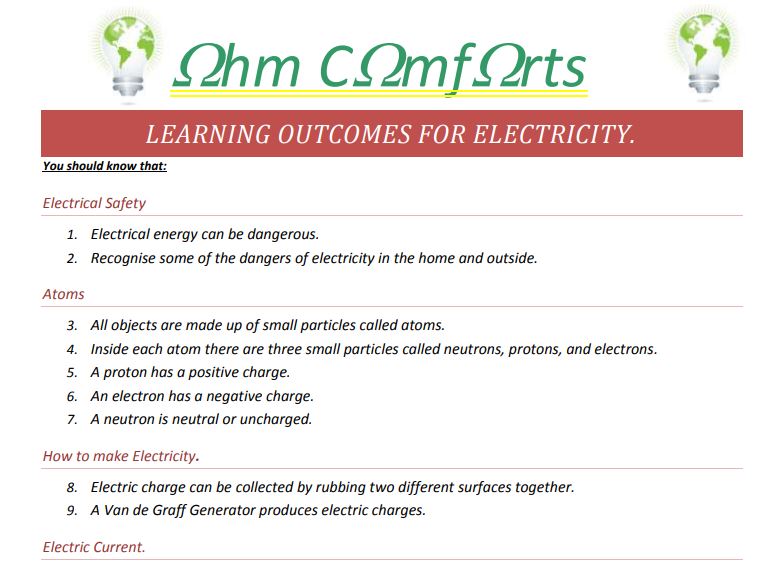
You should know that:
Electrical Safety
- Electrical energy can be dangerous.
- Recognise some of the dangers of electricity in the home and outside.
Atoms
- All objects are made up of small particles called atoms.
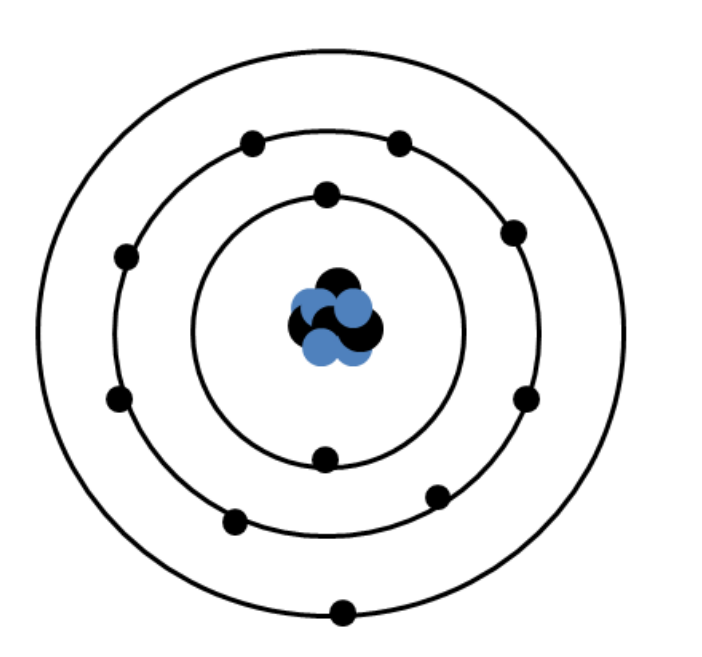
- Inside each atom there are three small particles called neutrons, protons, and electrons.
- A proton has a positive charge.
- An electron has a negative charge.
- A neutron is neutral or uncharged.
Watch the intro video clip for our Electricity Unit.
Watch the two video clips on Electrical Safety.
Electrical safety undated for UK. It does claim about 30 lives a year in the UK so don’t let it be you. Be safe around electricity!
The video below is the UK version of safety in the home.
http://www.twothirtyvolts.org.uk/electrical-safety/around-your-home.html
List 10 things to be aware of to be Electrically Safe, eg don’t put knives into toaster.
Atoms- what are they?
Watch the video -The Atom, write out the passage at the end of the video. Check your answers using the wordwall game (link below)
Check whether you have filled in the answers correctly by trying the wordwall
Draw the diagram of the Model of the Atom or print it out, stick it in and label it.
Lesson 2
Static Experiments
You should know
How to make Electricity.
- Electric charge can be collected by rubbing two different surfaces together.
- A Van de Graff Generator produces electric charges.
Check your answers from last lesson on the atom using the wordwall game. Review the work to make sure you could label a model of the atom.
Answer the microsoft Form on the Atom.
Static Electricity
Watch this video on static experiments. Try these at home and pop a picture in the comments of how you get on.
Watch the clips on the Van de Graaff Generator, it is just an effective way of collecting charge. There are instructions to make your own in the electrity notes in another post.
Try some of these experiments. NB styrofoam means polystyrene in the UK and try a plastic ruler if you haven’t got plastic pipe.
Here are the individual videos of the static experiments
Lesson 3 and 4
Lighting a bulb and making your own electrical kit! (or breaking up your old torch)
Conductors and Insulators
Watch the video How to Light a Bulb
Watch the video clip about Making your own Electricital Kit. Try making your own electrical kit and post some photos.
Watch the video clip to improve your circuit and try to put a switch in your own circuit if you make one.
Now use your circuit to test materials for conductors and insulators. Instructions are in the clip below. Don’t forget to record your results in the table shown.
A conductor is a material with free electrons that allows electrons through it. An insulator is a material where additional electrons cannot pass through.
Testing for Conductors and Insulators using your homemade electrical kit
TESTING FOR CONDUCTORS AND INSULATORS
Lesson 5
Drawing Circuit Symbols
You should know
Drawing Circuits.
- Circuit symbols are used to show how circuits can be built.
- The circuit symbol for a cell, switch, bell, ammeter, voltmeter, lamp, power supply, resistor, wire, connected wire.
- Make sure that you can draw circuits using the proper symbols and following the rules for drawing circuits.
Lesson 6
Multimeters
You should know
- A multimeter can be set up to measure current, resistance or voltage.
- When a multimeter is set up to measure current we call it an ammeter.
Resistance
- Some materials have a high resistance and make it difficult for current to flow.
- A continuity tester can be used to test for conductors and insulators.
- Resistance is a measure of how difficult it is for the charges to move through an object.
- The longer a wire the higher the resistance of the wire.
Voltage.
- For most materials, as you increase the voltage the current increases.
- Potential difference (p.d.) is often called voltage.
- p.d. is the push that makes the charges move around a circuit.
- Voltage is measured in volts.
- Voltage is measured using a voltmeter, symbol V
- Voltmeters are connected in parallel.
Watch the videos and answer the questions in the forms!
Lesson 7
Electrical Definitions
You should know
- When electric charge moves we call it an electric current.
- Current is a flow of charge (or electrons) around a circuit.
- Materials that allow current through them are called electrical conductors.
- Materials that do not allow current through them are called electrical insulators.
- We use the symbol I to represent current.
- Current is measured in amperes or amps.
- Current is measured using an ammeter.
- Ammeters are connected in series.
- The symbol for an ammeter
- For electrons to flow there must be a complete circuit.
- A multimeter can be set up to measure current, resistance or voltage.
- When a multimeter is set up to measure current we call it an ammeter.
- A multimeter can be set up to measure current, resistance or voltage.
- When a multimeter is set up to measure current we call it an ammeter.
- Some materials have a high resistance and make it difficult for current to flow.
- A continuity tester can be used to test for conductors and insulators.
- Resistance is a measure of how difficult it is for the charges to move through an object.
- The longer a wire the higher the resistance of the wire.
Voltage.
- For most materials, as you increase the voltage the current increases.
- Potential difference (p.d.) is often called voltage.
- p.d. is the difference in the energy the charge carriers have between two points.
- Voltage is measured in volts.
- Voltage is measured using a voltmeter, symbol V
- Voltmeters are connected in parallel.
Use the video to fill in the table of definitions
| Ammeter | Charge | Circuit | Conductor |
| Continuity tester | Current | Insulator | Multimeter |
| Ohmmeter | Parallel circuit | Potential Difference | Resistance |
| Series circuit | The effects of a current | Voltage | Voltmeter |
| Type | Yr | Q No. | Answer |
|---|---|---|---|
| Trad | 2001 | 4 b | a (OR F) is directly proportional to -x Usual now to use -y rather than -x |
| Trad | 2001 | 5 aii | (Electrostatic potential at a point) is the work done per unit charge moveing the charge from infinity to the point |
| Trad | 2001 | 11 a | electric field vibrates in all directions in unpolarised light vibrates in one plane only in polaried light |
| Trad | 2002 | 3 ci | velocity required by a body to escape earth gravitational field by reaching infinity |
| Trad | 2002 | 5 ai | diffraction pattern produced by electon beam |
| Trad | 2002 | 10 cii | wavelength has incerased therfore the source is moving away from the observer |
| Trad | 2006 | 3 ai | Force exerted on 1 kg (of mass) placed in the field |
| Trad | 2006 | 11 c | (Path length) in oil depends on angle of incidence or thickness ∴different colours are seen due to interference |
| Trad | 2009 | 8 b | One tesla is the magnetic induction of a magnetic field in which a conductor of length one metre, carrying a current of one ampere (perpendicular) to the field is acted on by a force of one newton. |
| Trad | 2009 | 9 ai | Division of amplitude is when some of the light reflects from the top of the air wedge and some is transmitted/refracted into the air. OR Some of the light is reflected from a surface of a new material/medium and some of the light is transmitted/refracted into the new material/medium. |
| Trad | 2009 | 10 a | A stationary wave is caused by interference effects between the incident and reflected sound. |
| Trad | 2009 | 10 b | The antinodes of the pattern are areas of maximum displacement/amplitude/disturbance The nodes of the pattern are areas of minimum/zero displacement/amplitude/disturbance |
| Trad | 2010 | 4 a | Total angular momentum before (an event) = total angular momentum after (an event) in the absence of external torques |
| Trad | 2010 | 6 bii | E-field is zero inside a hollow conductor. E-field has inverse square dependence outside the conductor. |
| Trad | 2010 | 11 a | unpolarised light => Electric field vector oscillates or vibrates in all planes polarised light => Electric field vector oscillates or vibrates in one plane |
| Trad | 2014 | 3 ai | The (minimum) velocity/speed that a mass must have to escape the gravitational field (of a planet). |
| Trad | 2014 | 4 ai | The unbalanced force/ acceleration is proportional to the displacement of the object and act in the opposite direction. |
| Rev | 2014 | 4 aii | The distance from the centre of a black hole at which not even light can escape. or The distance from the centre of a black hole to the event horizon. |
| Trad | 2014 | 5 di | Electron orbits a nucleus / proton , Angular momentum quantised or Certain allowed orbits / discrete energy level |
| Rev | 2014 | 6 aii | Photoelectric effect or Compton scattering Collision and transfer of energy |
| Rev | 2014 | 6 di | Electron orbits a nucleus / proton (1) Angular momentum quantised (1) or Certain allowed orbits / discrete energy level |
| Rev | 2014 | 8 a | The unbalanced force/ acceleration is proportional to the displacement of the object and act in the opposite direction. |
| Trad | 2014 | 11c | Wavelengths in the middle of the visible spectrum not reflected or destructively interfere. Red and blue reflected / combined to (form purple). |
| Trad | 2014 | 13 aii | The brightness would gradually reduce from a maximum at 0 degrees to no intensity at 90 degrees. It would then gradually increase in intensity from 90 degrees to 180 where it would again be at a maximum |
| Rev | 2015 | 1 c | The speed of the mass will be less. Second mark for correct justification. eg: Flywheel has greater moment of inertia Flywheel will be more difficult to start moving Smaller acceleration of flywheel More energy required to achieve same angular velocity. |
| Rev | 2015 | 2 a | Massive objects curve spacetime Other objects follow a curved path through this (distorted) spacetime |
| Rev | 2015 | 2 c | Time passes more slowly at lower altitudes (in a gravitational field). or Lower gravitational field strength at higher altitude. |
| Trad | 2015 | 3 biii | Potential is work done (per unit mass) moving from infinity to that point. or Infinity defined as zero potential. Work will be done by the field on the mass. or A negative amount of work will be done to move an object from infinity to any point. or WD by gravity in moving to that point or Force acts in opposite direction to r. |
| Rev | 2015 | 5 aiii | Difficult scale to read/information from diagram can only be read to 1 s.f. |
| Rev | 2015 | 6 ai | Force acting on (acceleration of) object is directly proportional to and in the opposite direction to its displacement. (from equilibrium) |
| Rev | 2015 | 7 aii | l reduced (or f increased) for X-rays or >E transferred D x reduced for X-rays since D x D p ³ h/4 p D p increases |
| Rev | 2015 | 7 b | since DEDt³ h/4 p Borrowing energy for a short period of time allows particles to escape |
| Rev | 2015 | 8 ai | Two sets of coherent waves are necessary (for an interference pattern) or (Interference patterns can be produced by) Division of wavefront. |
| Rev | 2015 | 9 ai | Force acts on particle at right angles to the direction of its velocity/motion or a central force on particle. |
| Rev | 2015 | 9 b | (Component of) velocity at right angles to field/ v sin θ, results in circular motion/central force. (Component of) velocity parallel to field/ v cosθ is constant/no unbalance force (in this direction). |
| Trad | 2015 | 9 bi | Magnetic fields/induction are equal in magnitude (½) and opposite in direction |
| Rev | 2015 | 10 ai | Force exerted per (unit) charge is constant at any point in the field |
| Rev | 2015 | 10 aiv | Any suitable answer eg Systematic uncertainty in measuring d or V Alignment of metre stick The flame has a finite thickness so cannot get exactly to the zero point. Factors causing field to be non-uniform. A p.d. across the resistor for all readings. Poor calibration of instruments measuring V or d. |
| Rev | 2015 | 10 b | Deflection is less. E is less. Force/acceleration is less |
| Rev | 2015 | 12 biii | Rate of change of current/magnetic field is at its maximum |
| Trad | 2016 | 5 ai | Frames of reference that are accelerating (with respect to an inertial frame) |
| Trad | 2016 | 5 aii | It is impossible to tell the difference between the effects of gravity and acceleration. |
| Trad | 2016 | 8 aii | The precise position of a particle/ system and its momentum cannot both be known at the same instant. OR If the uncertainty in the energy of the particle is reduced, the minimum uncertainty in the lifetime of the particle will increase (or vice-versa). |
| Trad | 2016 | 10 ai | displacement is proportional to and in the opposite direction to the acceleration |
Lesson 8
Building Circuits
Lesson 9
Modelling Series Circuits and Predicting Current and Voltage in a series circuit.
Series and Parallel Circuits
- The two types of circuit are called series and parallel.
- In series circuits the current is the same all round the circuit.
- In series circuits the voltage across the components adds up to give the voltage of the supply.
Watch the video, it takes you through a model to help us explain series circuits and the rules for current and voltage in a series circuit.
Lesson 10
Modelling Parallel Circuits and Predicting Current and Voltage in a Parallel circuit.
You should know
Series and Parallel Circuits
You should know that
- The two types of circuit are called series and parallel.
- In parallel circuits the current splits up and some goes down each branch.
- In parallel circuits the voltage is the same across each branch.
- The current drawn from the supply increases the more components are connected in parallel.
- When lamps are added in parallel the current drawn from the supply increases. This is because the overall resistance of the circuit is reduced.
The Parallel Model.
Watch the video and draw your own Town called Parallel Circuit
Note down what you expect then try things out of the Phet.
Lesson 11
Current and Voltage with Series and Parallel Circuits
You should know
Series and Parallel Circuits
- The two types of circuit are called series and parallel.
- In series circuits the current is the same all round the circuit.
- In parallel circuits the current splits up and some goes down each branch.
- In series circuits the voltage across the components adds up to give the voltage of the supply.
- In parallel circuits the voltage is the same across each branch.
- The current drawn from the supply increases the more components are connected in parallel.
- When lamps are added in parallel the current drawn from the supply increases. This is because the overall resistance of the circuit is reduced.
The current in series and parallel is a word version of the instructions for the videos above on setting up the Phet to check the rules for current and voltage in a series circuit. It would also be a great introduction to resistance
The current and voltage questions are based on the questions produced by Mr Belford and cover identifying current and voltage readings with series and parallel circuits.
Lesson 12
Fruity Batteries.
You should know
- How to design simple chemical cells and use them to investigate the factors which affect the voltage produced.
https://www.stevespanglerscience.com/lab/experiments/fruit-power-battery/