
Welcome to National 5 Physics.
We hope you will enjoy the experience of learning Physics over the next year. This information gives you a clear idea of the National 5 Physics course.
SURVIVING THE COURSE.
1. The structure of the Course.
The first thing to understand if you are to achieve your best in Physics at National 5, is to have a clear understanding of how the course is run. The course is made up of several parts; divided up in several ways.
There are six units and the Assignment (which changed for the session 2017-18):
- Waves
- Radiation
- Dynamics
- Space
- Electricity
- Properties of Matter
- Assignment (20% of the course covered in class but marked externally)
However, if you do units for N5, they have stayed as Dynamics and Spaces, Waves and Radiation and Electricity and Energy so there is quite a bit of overlap in the units.
The topics covered in each unit are given below:
- Dynamics – vectors and scalars; velocity–time graphs; acceleration; Newton’s laws; energy; projectile motion.
- Space – space exploration; cosmology.
- Electricity-electrical charge carriers; potential difference (voltage); Ohm’s law; practical electrical and electronic circuits; electrical power.
- Properties of matter –specific heat capacity; specific latent heat; gas laws and the kinetic model.
- Waves – the topics covered are: wave parameters and behaviours; electromagnetic spectrum; refraction of light.
- Radiation –is nuclear radiation.
Use the Learning Outcome Questions to check your understanding of the course content. The numbers match directly with the compendium and there are fully worked out solutions, find those in the Learning Outcome section
The QS states that the Assignment and Exam will test:
- knowledge and understanding of physics by making accurate statements
- knowledge and understanding of physics by describing information and providing explanations and integrating knowledge
- applying physics knowledge to new situations, interpreting information and solving problems
- planning or designing experiments to test given hypotheses or to illustrate particular effects, including safety measures
- carrying out experimental procedures safely
- selecting information from a variety of sources
- presenting information appropriately in a variety of forms
- processing information (using calculations and units, where appropriate)
- making predictions based on evidence/information
- drawing valid conclusions and giving explanations supported by evidence/justification
- evaluating experimental procedures
- suggesting improvements to experiments/practical investigations
- communicating findings/information
2. The “Need to Know Booklet” called Compendium and organising you work.
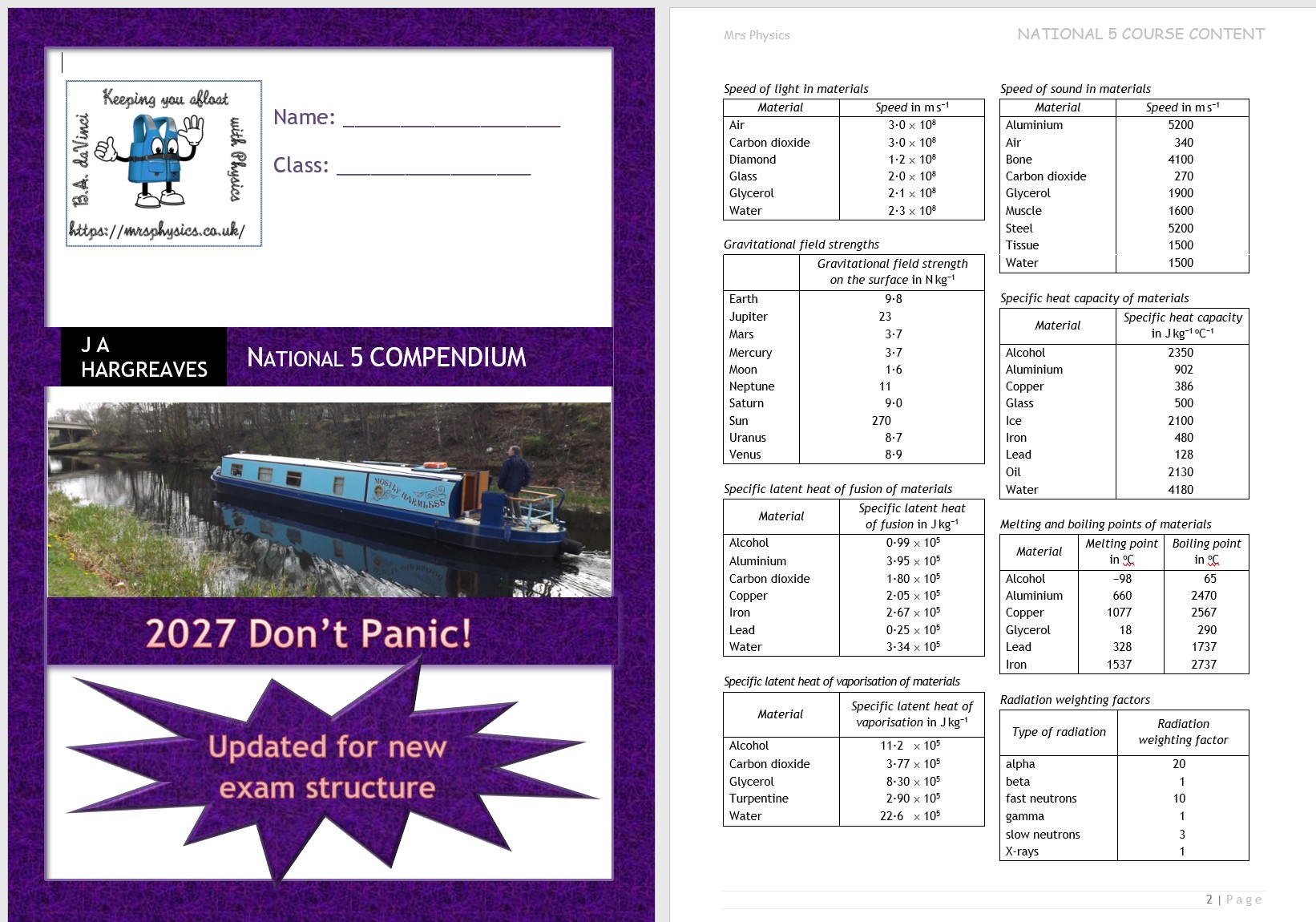
Currently, all the information you need to pass the exam is highlighted in the Compendium. Check this every lesson and note your progress through the course, ensure you understand what you need to know.
Completing the Learning Outcome Questions will provide you with a perfect set of revision notes. These should be answered clearly and concisely in your Notes. Either copy out each question or print the questions and stick these in your notes, or download a word copy of the LOQ and add in your answers. Get friends and family to test you on your answers or alternatively, you can make these into flash cards.
Another hint is to make your work as colourful and neat as possible. This is going to form your most important work so take care of it. If it is bright, colourful, well presented and laid out it will be easy to revise from.
At the back of the notes jotter keep a list of all of your quantities etc. in a table like the one below. These are also in the compendium.
| N | H | A | Physical Quantity | sym | Unit | Unit Abb. |
|---|---|---|---|---|---|---|
| 5 | absorbed dose | D | gray | Gy | ||
| 5 | absorbed dose rate | H (dot) | gray per second gray per hour gray per year | Gys-1 Gyh -1 Gyy-1 | ||
| 5 | 6 | 7 | acceleration | a | metre per second per second | m s-2 |
| 5 | 6 | 7 | acceleration due to gravity | g | metre per second per second | m s -2 |
| 5 | activity | A | becquerel | Bq | ||
| 5 | 6 | 7 | amplitude | A | metre | m |
| 5 | 6 | 7 | angle | θ | degree | ° |
| 5 | 6 | 7 | area | A | square metre | m 2 |
| 5 | 6 | 7 | average speed | v (bar) | metre per second | m s-1 |
| 5 | 6 | 7 | average velocity | v (bar) | metre per second | m s -1 |
| 5 | 6 | 7 | change of speed | ∆v | metre per second | m s -1 |
| 5 | 6 | 7 | change of velocity | ∆v | metre per second | m s-1 |
| 5 | count rate | - | counts per second (counts per minute) | - | ||
| 5 | 6 | 7 | current | I | ampere | A |
| 5 | 6 | 7 | displacement | s | metre | m |
| 5 | 6 | 7 | distance | d | metre, light year | m , ly |
| 5 | 6 | 7 | distance, depth, height | d or h | metre | m |
| 5 | effective dose | H | sievert | Sv | ||
| 5 | 6 | 7 | electric charge | Q | coulomb | C |
| 5 | 6 | 7 | electric charge | Q or q | coulomb | C |
| 5 | 6 | 7 | electric current | I | ampere | A |
| 5 | 6 | 7 | energy | E | joule | J |
| 5 | equivalent dose | H | sievert | Sv | ||
| 5 | equivalent dose rate | H (dot) | sievert per second sievert per hour sievert per year | Svs-1 Svh-1 Svy -1 | ||
| 5 | 6 | 7 | final velocity | v | metre per second | m s-1 |
| 5 | 6 | 7 | force | F | newton | N |
| 5 | 6 | 7 | force, tension, upthrust, thrust | F | newton | N |
| 5 | 6 | 7 | frequency | f | hertz | Hz |
| 5 | 6 | 7 | gravitational field strength | g | newton per kilogram | N kg-1 |
| 5 | 6 | 7 | gravitational potential energy | Ep | joule | J |
| 5 | half-life | t1/2 | second (minute, hour, day, year) | s | ||
| 5 | 6 | heat energy | Eh | joule | J | |
| 5 | 6 | 7 | height, depth | h | metre | m |
| 5 | 6 | 7 | initial speed | u | metre per second | m/s |
| 5 | 6 | 7 | initial velocity | u | metre per second | m s-1 |
| 5 | 6 | 7 | kinetic energy | Ek | joule | J |
| 5 | 6 | 7 | length | l | metre | m |
| 5 | 6 | 7 | mass | m | kilogram | kg |
| 5 | number of nuclei decaying | N | - | - | ||
| 5 | 6 | 7 | period | T | second | s |
| 5 | 6 | 7 | potential difference | V | volt | V |
| 5 | 6 | 7 | potential energy | Ep | joule | J |
| 5 | 6 | 7 | power | P | watt | W |
| 5 | 6 | 7 | pressure | P or p | pascal | Pa |
| 5 | radiation weighting factor | wR | - | - | ||
| 5 | 6 | 7 | radius | r | metre | m |
| 5 | 6 | 7 | resistance | R | ohm | Ω |
| 5 | 6 | 7 | specific heat capacity | c | joule per kilogram per degree Celsius | Jkg-1°C -1 |
| 5 | 6 | specific latent heat | l | joule per kilogram | Jkg-1 | |
| 5 | 6 | 7 | speed of light in a vacuum | c | metre per second | m s-1 |
| 5 | 6 | 7 | speed, final speed | v | metre per second | ms -1 |
| 5 | 6 | 7 | speed, velocity, final velocity | v | metre per second | m s-1 |
| 5 | 6 | 7 | supply voltage | Vs | volt | V |
| 5 | 6 | 7 | temperature | T | degree Celsius | °C |
| 5 | 6 | 7 | temperature | T | kelvin | K |
| 5 | 6 | 7 | time | t | second | s |
| 5 | 6 | 7 | total resistance | R | ohm | Ω |
| 5 | 6 | 7 | voltage | V | volt | V |
| 5 | 6 | 7 | voltage, potential difference | V | volt | V |
| 5 | 6 | 7 | volume | V | cubic metre | m3 |
| 5 | 6 | 7 | weight | W | newton | N |
| 5 | 6 | 7 | work done | W or E W | joule | J |
| 7 | angle | θ | radian | rad | ||
| 7 | angular acceleration | a | radian per second per second | rad s-2 | ||
| 7 | angular displacement | θ | radian | rad | ||
| 7 | angular frequency | ω | radian per second | rad s-1 | ||
| 7 | angular momentum | L | kilogram metre squared per second | kg m2s -1 | ||
| 7 | angular velocity, final angular velocity | ω | radian per second | rad s-1 | ||
| 7 | apparent brightness | b | Watts per square metre | Wm-2 | ||
| 7 | back emf | e | volt | V | ||
| 6 | 7 | capacitance | C | farad | F | |
| 7 | capacitive reactance | Xc | ohm | W | ||
| 6 | critical angle | θc | degree | ° | ||
| density | ρ | kilogram per cubic metre | kg m-3 | |||
| 7 | displacement | s or x or y | metre | m | ||
| efficiency | η | - | - | |||
| 6 | 7 | electric field strength | E | newton per coulomb volts per metre | N C-1 Vm-1 |
|
| 7 | electrical potential | V | volt | V | ||
| 6 | 7 | electromotive force (e.m.f) | E or ε | volt | V | |
| 6 | energy level | E1 , E2 , etc | joule | J | ||
| feedback resistance | Rf | ohm | Ω | |||
| focal length of a lens | f | metre | m | |||
| 6 | frequency of source | fs | hertz | Hz | ||
| 6 | 7 | fringe separation | ∆x | metre | m | |
| 6 | 7 | grating to screen distance | D | metre | m | |
| 7 | gravitational potential | U or V | joule per kilogram | J kg-1 | ||
| half-value thickness | T1/2 | metre | m | |||
| 6 | 7 | impulse | (∆p) | newton second kilogram metre per second | Ns kgms-1 |
|
| 7 | induced e.m.f. | E or ε | volt | V | ||
| 7 | inductor reactance | XL | ohm | W | ||
| 7 | initial angular velocity | ω o | radian per second | rad s-1 | ||
| input energy | E i | joule | J | |||
| input power | Pi | watt | W | |||
| input voltage | V1 or V2 | volt | V | |||
| input voltage | V i | volt | V | |||
| 6 | internal resistance | r | ohm | Ω | ||
| 6 | 7 | irradiance | I | watt per square metre | W m-1 | |
| 7 | luminoscity | L | Watt | W | ||
| 7 | magnetic induction | B | tesla | T | ||
| 7 | moment of inertia | I | kilogram metre squared | kg m2 | ||
| 6 | 7 | momentum | p | kilogram metre per second | kg m s-1 | |
| 6 | number of photons per second per cross sectional area | N | - | - | ||
| number of turns on primary coil | np | - | - | |||
| number of turns on secondary coil | ns | - | - | |||
| 6 | observed wavelength | λobserved | metre | m | ||
| output energy | Eo | joule | J | |||
| output power | Po | watt | W | |||
| output voltage | Vo | volt | V | |||
| 6 | peak current | Ipeak | ampere | A | ||
| 6 | peak voltage | V peak | volt | V | ||
| 7 | phase angle | Φ | radian | rad | ||
| 6 | 7 | Planck’s constant | h | joule second | Js | |
| 7 | polarising angle (Brewster’s angle) | ip | degree | ̊ | ||
| power (of a lens) | P | dioptre | D | |||
| power gain | Pgain | - | - | |||
| 7 | Power per unit area | Watts per square metre | Wm-2 | |||
| primary current | Ip | ampere | A | |||
| primary voltage | Vp | volt | V | |||
| 7 | radial acceleration | ar | metre per second per second | m s-2 | ||
| 6 | redshift | z | - | - | ||
| 6 | 7 | refractive index | n | - | - | |
| 6 | relativistic length | l' | metre | m | ||
| 6 | relativistic time | t' | second | s | ||
| rest mass | mo | kilogram | kg | |||
| 6 | rest wavelength | λrest | metre | m | ||
| 6 | root mean square current | I rms | ampere | A | ||
| 6 | root mean square voltage | Vrms | volt | V | ||
| 7 | rotational kinetic energy | Erot | joule | J | ||
| 7 | schwarzchild radius | rSchwarzchild | metre | m | ||
| secondary current | Is | ampere | A | |||
| secondary voltage | Vs | volt | V | |||
| 7 | self-inductance | L | henry | H | ||
| 6 | 7 | slit separation | d | metre | m | |
| 7 | tangential acceleration | at | metre per second per second | m s-2 | ||
| 6 | threshold frequency | fo | hertz | Hz | ||
| 7 | time constant | t | second | s | ||
| 7 | torque | Τ | newton metre | Nm | ||
| 7 | uncertainty in Energy | ∆E | joule | J | ||
| 7 | uncertainty in momentum | ∆px | kilogram metre per second | kgms-1 | ||
| 7 | uncertainty in position | ∆x | metre | m | ||
| 7 | uncertainty in time | ∆t | second | s | ||
| 6 | velocity of observer | vo | metre per second | m s-1 | ||
| 6 | velocity of source | vs | metre per second | m s-1 | ||
| voltage gain | - | - | - | |||
| voltage gain | Ao or V gain | - | - | |||
| 5 | 6 | 7 | wavelength | λ | metre | m |
| 6 | work function | W | joule | J |
Your formulae should also be in the notes section. Keep the list up to date! Each time that you learn a new formula put this in your notes. Make sure you include units, symbols and the meaning of each letter. Check that you can rearrange the formula to find any missing quantity.
Keep track of your progress honestly, by regularly filling in your bullseye sheet.
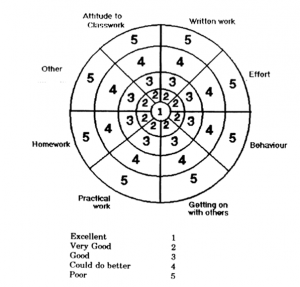
Review your progress with your teacher regularly and note any concerns and comments and deal with these as soon as possible. This may be in the form of additional work, additional help or additional resources. Your pupil profiles can tell us when you’re really happy with the course, enjoying it and feel that you are making good progress. Don’t rush your response, but engage with how you can improve and what areas you feel are your weakest and strongest.
Science is about trial and error and looking for ways to fix mistakes, what a better example for life!
3. Homework and Review
You will be expected to complete all the homework set and hand it in on time. We will contact parents/carers if we think you are not completing this vital part of the course. We do not issue homework because we want you to spend all your life working, but because it gives you the opportunity to consolidate the work completed in class. It has been proved that students who complete homework do better in their exams.
4. The Timeline
Creating a timeline will assist in planning your way through the course. Remember to get to the end you will need to cover each section of the course, understand each section and then learn it. It has to be in that order.
5. ASK!
If you do not understand any aspect of the course or work and you have read through the material at home then ask.
6. Equipment
This is a list of the equipment you need to bring to Physics
- Pen
- Pencil
- Ruler (30 cm)
- Eraser
- Protractor or angle measurer.
- Scientific calculator, nothing fancy but it must be capable of doing scientific functions. Most pupils find it easier to use a Casio DAL, S-VPAM calculator, particularly the Casio FX83 or Casio FX85. With these calculators you enter the numbers into the calculator in the manner in which they are written. There is a post in the maths section giving you some example of how to work your calculator and I’ll add a few more hints later in the year.
7. Take Responsibility for your Learning
Sometimes there may be a distraction in the classroom that is out of our control. Make sure that you use your time wisely if there is a distraction. Check and complete one or more of the activities listed below.
- Finish off the work that has been set.
- Complete Learning Outcome Questions/ Summary of content statements.
- Check off the content covered in the Vital Booklet (good name needed)
- Write out a summary of what you have been doing.
- Read through the work that we have been covering.
- Read through the next section of work to prepare.
- Revise/ Learn your formulae
- Produce a revision test for the class.
Your work is in your hands. This is time that can be used or abused. If you abuse your time now you will have to use your free time later. SPEND YOUR TIME WELL.
8. Layout for Tackling Mathematical Problems
Always set out maths problems using the structure given below. It may seem to take longer but it will save time in the long run as it makes the question clearer.
USE IESSUU
http://www.youtube.com/watch?v=u7akhlAS5Ck
- Information– Summarise the question by writing down what you know from the information given. Use the letter that goes with the quantity and this will help you be able to work out the correct formula
- Equation – write down the equation as it occurs in the data sheet. Do not attempt to rearrange it before substituting.
- Substitution – put the numbers into the equation as they appear in the formula
- Solution – work out the answer. You are ALWAYS allowed to use a calculator
- Units– you will need to use the correct units so will need to learn these. No or wrong units no mark for the answer
- Underline – underline with 2 lines the answer to make it clear what is your final answer.
In short:
- (Information)- Summarise the question.
- Change any units that are not standard.
- (Equation) -Write out the formula.
- (Substitution) -Put the numbers in.
- Use the magic triangle to rearrange the formula, only if you must!
- (Solution)- Work out the answer.
- Write out the answer, but not to too many sig fig.
- (Units) -Add units to your answer.
- (Underline) Underline the answer.
http://www.mrsphysics.co.uk/usefullinks/general-marking-principles/
http://www.sqa.org.uk/sqa/files_ccc/Physicsgeneralmarkingprinciples.pdf
9. Revising The Syllabus
REVISING- Here are some really important ideas to help you with your revision (which shouldn’t just take place the night before a test but should be an ongoing process).
Find out:
- About the Exam www.sqa.org.uk exam timetable
- The Content that you are required to learn Course Specification
- Look through relevant Past Papers

- Make a Revision Calendar (I’ve made one for you Click Here! ) or if you want something more substantial try this, but you’ll need to do lots of editing to get your dates correct. Build your own revision timetable
- Stick a large calendar next to where you study.
- Mark in the dates and times of Exams (whether prelims or final exams). A countdown timer is on the N5 Home Page.
- Shade in the dates and times of other commitments.
- Make a list of topics to cover for each subject.
- Calculate how many hours you have available and how much time you will allocate to each subject.
- Decide on the order in which to tackle your subjects. Don’t tackle the easy subjects first as you’ll never get on to the harder ones! It is best to start revising the hard subjects and topics as these will take you more time to learn
- Draft your revision timetable.
- Leave one or two revision slots free each week for extra revision or difficult topics.
- BE SURE TO LEAVE YOURSELF SOME TIME FOR REST AND FUN ACTIVITIES including being healthy.
Working in Revision Groups
This can be useful but:
- Discipline is needed
- Decide before you meet on the topic that you’ll cover e.g. prepare revision cards or answer past paper questions.
- Teach each other a topic
- Take an ACTIVE APPROACH to your Revision
- Talking with others about what to revise can lessen the anxiety.
- Before starting a Session decide HOW and WHAT to revise
DON’T JUST SIT THERE READING AND RE-READING YOUR NOTES.
A STEP BY STEP REVISION STRATEGY
- FIND A FOCUS
- MAKE REVISION CARDS
- TEST YOURSELF
- LEARN IT!
- TEST YOURSELF
- CHECK IT!
10. Relax
Believe it or not we also expect you to make sure you relax. Relaxation should be in proportion. Too much and you won’t finish the work, too little and you will not function properly; balance is important. Make sure that your relaxation includes plenty of exercise and fresh air. Don’t just vegetate in front of something electrical.
Now you have your survival guide may we wish you all the best and hope you perform Physics to the best of your ability, whatever that standard!
Remember we are a TEAM! It is not YOU ALONE! It will be most effective if YOU, ME and PEOPLE FROM HOME can all work together to support you through the next nine months. We each have a role to play. I need to explain what we need to do in the best way I can, and ensure you know the course content. Your role is to listen well in class, learn what you are taught, ask if you have not understood what you’ve been taught and review and revise little and often. Tell me if you are finding the work hard so that I can give you additional support. People at home are there to support and encourage you in your work and if possible test you on your learning, (provided you’ve laid it out as well as possible).
After a Test
It is important that you review your performance after a test. One way to do that is through a Thinking about Revising Sheet. Also get a checklist of your mistakes, for example did you rearrange equations incorrectly, not use Scientific Language, misinterpret the question, etc. Often if you do a tally chart of mistakes it will highlight the ones you should focus on.
| Mistake | No. of ocassions | Content statement |
|---|---|---|
| Wrong units | ||
| Did not understand question | ||
| Did not read question carefully | ||
| Wrong maths | ||
| No summary of question | ||
| No units | ||
| Wrong Formula | ||
| Had not revised this section | ||
| Wrong substitution | ||
| Wrong value for quantity | ||
| lack of working | ||
| changing units wrongly | ||
| significant figures | ||
| m/c wrongly recorded | ||
| no direction on vectors | ||
| failure to spot importance of vectors | ||
| leaving out a question | ||
| wrongly transcribing a number | ||
| poor/ missing explanation | ||
| wrong facts | ||
| wrong diagrams | ||
| not getting data from data sheet | ||
| powers of 10/ prefixes/sci-notation | ||
| ran out of time | ||
| lack of information esp on diagram | ||
| wrongly rearranging formulae | ||
| not using data book/ making up eq! | ||
| selecting the wrong equation | ||
| prefixes |
You could see if this sheet is helpful too.
Thinking about revising this is the pdf version
Thinking about revising this is the word version
Here is the link to the QS N5 Physics website
Best Wishes for a lovely journey through N5 Physics

Updated February 2026

