
This post is suitable for students and teachers. Please let me know if you want me to split it up.
At the bottom of this post is a comment about describing requirements for pupil graphs. Well worth a read.
A set of PRACTICAL EXPERIMENTAL SHEETS that are in line with the changes brought in for the 2020/21 session. Teachers you are expected to check the validity of these. I’d love feedback on those you’ve tried and seem to get a good mark.
This table has the worksheets in word form.
| Topic | Sheet | Notes |
|---|---|---|
| Dynamics / Space | N5 Hookes Law A | Hookes Law A |
| Dynamics / Space | N5 Hookes Law B | Hookes Law B |
| Dynamics | N5 Acc slope | Acceleration and angle of the slope |
| Dynamics | N5 F=m a A | F=ma changing mass :A |
| Dynamics | N5 F=m a B | F=ma changing mass: B |
| Dynamics | N5 projectiles A | Projectiles changing the launch angle: A |
| Dynamics | N5 projectiles B | Projectiles changing the launch speed: B |
| Dynamics | N5 projectiles C | Projectiles changing the launch height: C |
| Dynamics | N5 Stopping distance A | How the speed affects the stopping distance |
| Dynamics | N5 Stopping distance B | How the speed affects the stopping distance |
| Dynamics | Pendulum and length | |
| Prop. of Matter | ||
| Prop. of Matter | N5 Charles' Law A | Volume and Temperature with constant pressure |
| Prop. of Matter | N5 Boyles Law A | Pressure and volume for constant temperature |
| Prop. of Matter | N5 Boyles Law B | Pressure and volume for constant temperature: A |
| Prop. of Matter | N5 Pressure Law A | Pressure and Temperature for constant volume: B |
| Prop. of Matter | N5 Pressure and depth A | Effects of pressure of a liquid with depth |
| Prop. of Matter | N5 SHC A | Specific Heat Capacity measure V and I |
| Prop. of Matter | N5 SHC B | Specific Heat Capacity using joule meter |
| Prop. of Matter | N5 Cooling Curve A | Cooling curve of water and stearic acid |
| Prop. of Matter | N5 Latent heat of vaporisation A | Determining latent heat of vaporisation A |
| Prop. of Matter | N5 Latent heat of vaporisation B | Determining latent heat of vaporisation B |
| Electricity / Energy | N5 Solar Cell A angle | Solar Cells A Angle |
| Electricity / Energy | N5 Solar Cell B distance | Solar Cells B Distance |
| Electricity / Energy | N5 Solar Cell C translucent | Solar Cells C Translucent |
| Electricity / Energy | N5 Solar Cell D area | Solar Cells D Area |
| Electricity | N5 Ohms Law A | Measuring voltage and current for a ohmic conductor (resistor) |
| Electricity | N5 Ohms Law B | Measuring voltage and current for a non-ohmic conductor |
| Electricity | N5 Thermistors A 2023 | Thermistors |
| Electricity | N5 LED 2023 | LEDs |
| Electricity | N5 LDR A | An LDR -distance from the light source. |
| N5 Assign LDR B | An LDR - light intensity: B | |
| Electricity | N5 Assign LDR C | Calibrating an LDR against a light level meter |
| Space | Orbit period v height |
|
| Waves / Space | Microwave distance v signal strength | |
| Waves | N5 Speed of Sound | Speed of Sound |
| Waves | N5 Refraction A | Refraction |
| Radiation |
Assignment Investigation Sheets
NOTE: TO ALL TEACHERS, IT IS YOUR RESPONSIBILITY TO CHECK THE SHEETS YOU ARE GIVING TO STUDENTS DO NOT BREACH THE STRICT GUIDELINES GIVEN IN THE ASSESSMENT GUIDE AND THAT THESE EXPERIMENT SHEETS MEET THE SPECIFICATIONS. YOU ARE ALSO RESPONSIBLE FOR CHECKING YOUR OWN RISK ASSESSMENTS, ITEMS IN THESE SHEETS ARE A GUIDE.
Warning about the Choice of Investigation
“The experiments detailed in the course specification can be used. Centres are obviously free to choose other experiments if they wish, as long as they’re commensurate with the level. One of the advantages of using the experiments in the course is that you can be sure that the physics is accessible and at the correct level.
In the past, we saw some examples where centres had used rotational motion experiments with N5 candidates, and you could tell that the candidates had no clue what they were doing. It’s also been obvious at National 5 level that some centres are still using kits they had for Standard Grade investigations, which is fine, but you do need to make sure that the underlying physics is accessible. To give an example, solar cells was always a popular topic for Standard Grade and we see centres using them for National 5, but explaining how a solar cell produces a potential difference is something N5 candidates will probably struggle with.
Your colleagues may wish to have a look at the Physics pages on the Understanding Standards website:
SQA – Understanding Standards: Introduction (Nat 5)
where they will see several exemplars based on the experiments detailed in the course specification.
If you have things that have worked well in the past, then it’s worth remembering that nothing has changed in any of the coursework requirements, and therefore they should still work in the same way.”
Here is a marking grid, obviously only if you are able to find time for a practice. It is not to be used to tentatively mark the student assignment being sent to the SQA.
SQA Good Guy
3779phys2_tcm4-124418 Again this is a temporary file until I can get the experiment cards organised but the experiments you could choose can be found on pp 33, 34, 36, 37, 76, 77, 87, 125
This is the info for N5 from August 2020
Student Information
The material has been published on the Understanding Standards Website SQA Physics N5 INFO
N5 Candidate 1 N5 Commentary 1
Above gives an example of the new Assignment requirements. It is vital that you don’t copy or even attempt to copy this assignment. If you are likely to copy other people’s work it is best to choose another topic.
Initial Task- vital
| Section | Expected response | Max mark |
|---|---|---|
| Title | The report has an informative title. | 1 |
| Aim | A description of the purpose of the investigation. | 1 |
| Underlying physics relevant to the aim | A description of the physics relevant to the aim which shows understanding. | 3 |
| Data collection and handling | A brief description of the experiment. | 1 |
| Sufficient raw data from the experiment. | 1 | |
| Raw data presented in a table with headings and units. | 1 | |
| Values correctly calculated from the raw data. | 1 | |
| Data from an internet/literature source. | 1 | |
| A reference for the internet/literature source. | 1 | |
| Graphical presentation | The correct type of graph used to present the experimental data. | 1 |
| Suitable scales. | 1 | |
| Suitable labels and units on axes. | 1 | |
| All points plotted accurately, with line or curve of best fit if appropriate. | 1 | |
| Analysis | Experimental data compared to data from internet/literature source. | 1 |
| Conclusion | A conclusion related to the aim and supported by data in the report. | 1 |
| Evaluation | A discussion of a factor affecting the reliability, accuracy or precision of the results. | 2 |
| Structure | A report which can be easily followed. | 1 |
| TOTAL MARKS | 20 |
Before Starting on your assignment take time to go over the following, it is vital that you know what you are doing.
The first thing that you must do before starting your Assignment is to know what you will be doing, what expectations there are and how you will be writing this up. All of this is contained in the candidate guide below.
Marking Instructions for the N5 Assignment
mark scheme pdf form
mark scheme excel form
You must also correctly reference your work, learn how to do this with the following link.
Exeter.ac.uk/studyskills/harvard_referencing.htm
N5 Assignment instructions (pdf file)
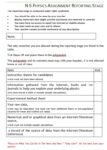
To kick you off with your assignment Mr Forwood has supplied the following document.
N5 Assignment instructions (editable in word)
Pupil checklist flyleaf pdf (Thanks N Forwood)
Here is the what you can take into the write-up phase. Collect a polypocket and keep it all in there.
National 5 Assignment Material
ASSIGNMENT INSTRUCTIONS FROM THE SQA
When choosing a topic for an assignment check that:
- the theory is in the compendium,
- the topic is in the course,
- there is a graph of your experiment online or in one of the text books in school. Does your graph contain data ie, are there proper points on the graph or is it a trendline- which do you think is better?
- there is theory that you can write about that relates to your experiment.
Remember If you’ve used the results from your experiment to determine further values, you should show at least one sample calculation.
I think the following experiments might be suitable-
3779phys2_tcm4-124418 Again this is a temporary file until I can get the experiment cards organised but the experiments you could choose can be found on pp 33, 34, 36, 37, 76, 77, 87, 125
Understanding Standards Webinar
How to record your relationships!
This is not a discussion about your friendships but how the data can be described.
The best terminology to use for graphs that have
a trend which is a straight line is ‘a linear relationship’.
That avoids issues around whether something is directly proportional or proportional.
Directly proportional only applies when the graph is a straight line through the origin (or close to the origin within the uncertainty in the y-intercept). It is best to avoid ‘proportional’ altogether.
A curve, such as that produced when plotting mass against acceleration for a constant force, can never be described as showing an ‘inversely proportional’ relationship, since it does not show the actual relationship (it could potentially be any number of different relationships).
Inverse proportionality can only be claimed when the correct graph of, for example, acceleration against 1/m is drawn, and it produces a straight line through the origin.
The type of graph produced for an internal resistance experiment is covered by the term ‘linear relationship’, as it follows the equation y=mx+c format.

Mrs Physics
Updated Feb 2026

